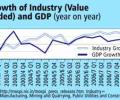
The case for a swift and sizable reduction in the repo rate rests on several pillars. First, and most importantly, there is mounting evidence that the five-year old surge in India's economic growth, especially industrial growth, peaked a few months back.

The Reserve Bank on Friday retained GDP growth forecast of 7 per cent for 2024-25 financial year, lower than the 7.6 per cent expansion estimated for FY24. In its February monetary policy, the RBI had projected the GDP growth rate of 7 per cent for the financial year beginning April 1. Announcing the current fiscal's first bi-monthly monetary policy, RBI Governor Shaktikanta Das said the rural demand is gathering pace, and sustained growth in manufacturing sector should boost private investment.

RBI's interest rate decision, macroeconomic data announcements and global trends are the key factors that would dictate the momentum in the equity market this week, analysts said.

The size of the Reserve Bank's balance sheet as on March 31, 2025 increased by 8.20 per cent year-on-year, leading to a bumper dividend of Rs 2.69 lakh crore for the central government. Increase on assets side was due to rise in gold, domestic investments and foreign investments by 52.09 per cent, 14.32 per cent and 1.70 per cent, respectively, said the RBI's Annual Report for the Year 2024-25 released on Thursday.

The Reserve Bank's rate-setting panel began its three-day deliberations on Monday to decide the next monetary policy amid expectations that the central bank will maintain status quo on the benchmark interest rate in the backdrop of global scare due to the new coronavirus variant Omicron. Reserve Bank Governor Shaktikanta Das headed six-member Monetary Policy Committee (MPC) is scheduled to announce the policy resolution on Wednesday. If the RBI maintains status quo in policy rates on Wednesday, it would be the ninth consecutive time since the rate remains unchanged.

A day after his appointment as the 26th governor of the Reserve Bank of India (RBI), outgoing Revenue Secretary Sanjay Malhotra on Tuesday said one must understand the economic landscape and do what was best for the economy. "Let me first go, join, understand the turf ... Here it is a different role," Malhotra said, speaking to reporters in front of North Block.

Even as the high inflation figure for October has ruled out any possibility of a rate cut by the Reserve Bank of India's (RBI's) monetary policy committee (MPC) in December, a rate cut in February also looks uncertain due to global uncertainties. Economists told Business Standard that unless domestic growth slows markedly, the outlook on rate cut remains unclear. India's headline inflation touched a 14-month high of 6.2 per cent in October, breaching the MPC's upper tolerance band of 6 per cent.

Volatility is likely to continue in the stock market this week amid Omicron uncertainty and the RBI monetary policy meeting will be a key driver for benchmark indices going ahead, say analysts. It will be an event-packed week for the markets, with RBI policy and several macroeconomic numbers scheduled to be announced, they added. "Volatility is likely to continue amid Omicron uncertainty, RBI credit policy, and macroeconomic numbers. "There are lots of news flows on the Omicron variant which are causing volatility in the market while on the domestic front we will have the outcome of an important monetary policy of RBI that is scheduled on December 8. "We will also have our IIP and inflation numbers this week however they will be released on Friday after market hours," said Santosh Meena, Head of Research, Swastika Investmart Ltd.

'Credit growth in India remains in double digits, even though corporate borrowing is subdued.' 'Corporate credit is weak because companies are cash-rich and cautious amid global uncertainty.'

Reserve Bank on Wednesday cut India's growth forecast to 6.5 per cent from 6.7 per cent estimated earlier for the current financial year on account of impact of global trade and policy uncertainties. Prospects of agriculture sector remain bright on the back of healthy reservoir levels and robust crop production in 2025-26, RBI Governor Sanjay Malhotra said while unveiling the outcome of the first bi-monthly Monetary Policy Committee meeting for the current financial year.
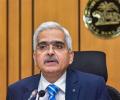
The Reserve Bank of India on Thursday decided to keep policy rate unchanged for the sixth time in a row as it maintains a tight vigil on inflation. The rate increase cycle was paused in April last year after six consecutive rate hikes aggregating to 250 basis points since May 2022.

The impact of RBI's monetary policy on the Aam Aadmi of India is going to be minimal.

Investors were focussed on the RBI's monetary policy review on Tuesday which will give an insight into its inflation and rates outlook.

A Kotak research report expects RBI to cuts rates by 50 basis points in the first half of 2019. RBI will announce its sixth bi-monthly monetary policy on February 7.
With retail inflation witnessing significant uptick in May, the Reserve Bank of India (RBI) is likely to maintain status quo in its August monetary policy review, according to a report. According to the SBI's research report- Ecowrap, inflation may remain elevated in the coming months due to several global and domestic factors. "We expect a status-quo in August. We believe RBI would still try to find a marriage of convenience of regulatory and developmental measures and monetary policy in August policy," the research report said on Wednesday.
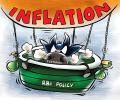
The RBI's Monetary Policy Committee brainstormed the impact of any future shocks on the inflation trajectory and stressed monitoring the cumulative effect of monetary policy actions over the past one year, which is still unfolding, revealed minutes of the rate-setting panel released on Thursday. The minutes of the meeting of the Monetary Policy Committee (MPC), headed by Reserve Bank Governor Shaktikanta Das, also indicated it would be premature to declare an end to the monetary tightening cycle, which started in May 2022 to check high inflation following the outbreak of the Russia-Ukraine war. The central bank, which effected six back-to-back hikes in the key short-term lending rate (repo) since May 2022 to check high inflation, decided to take a pause early this month.

The government on Monday ruled out making public the RBI report detailing the reasons why the central bank could not keep inflation within the targeted 6 per cent upper limit for the three consecutive quarters. "Yes sir, RBI has furnished a report to the central government, as mandated under Section 45ZN of the RBI Act, 1934 and Regulation 7 of RBI Monetary Policy Committee and Monetary Policy process Regulations, 2016," minister of state for finance Pankaj Chaudhary said in a written reply. The said provisions of the RBI Act, 1934, and regulations therein does not provide for making the report public, he said.
With concern on food inflation ebbing with the monsoon progressing well, the Reserve Bank of India (RBI) is warming up to the idea of a change in stance to "neutral" from "withdrawal of accommodation", according to economists. In his speech on Thursday during the annual event of the Federation of Indian Chambers of Commerce and Industry-Indian Banks' Association, RBI Governor Shaktikanta Das said: "The balance between inflation and growth is well-poised."

Widespread use of crypto assets, including stablecoins, can have a negative impact on the macroeconomic and financial stability of a country, the Reserve Bank of India (RBI) said on Monday. In its Financial Stability Report (FSR), the banking regulator highlighted that excessive use of crypto assets can reduce effectiveness of monetary policy, worsen fiscal risks, circumvent capital flow management measures, divert resources available for financing the real economy and threaten global financial stability.

The Reserve Bank on Friday said India is poised to become the growth engine of the world as it retained the GDP projection for the current fiscal at 6.5 per cent. Unveiling the bi-monthly monetary policy review, Reserve Bank of India (RBI) Governor Shaktikanta Das said the domestic economy exhibits resilience on the back of strong demand.

Sir Osborne Smith was the first governor of the Reserve Bank, serving from April 1, 1935, to June 30, 1937.

The rupee continued to face pressure in the first half of the current financial year (FY26), hitting fresh lows against the dollar, due to strengthening of the greenback, rising crude oil prices, and foreign outflows. Rupee has depreciated by 3.7 per cent so far in the current financial year after starting at a good note in April.

S&P Global Ratings on Tuesday retained India's growth forecast at 6.8 per cent for the current fiscal and said it expects the RBI to start cutting interest rates in its October monetary policy review. In the economic outlook of Asia Pacific, S&P Global Ratings also retained its GDP growth forecast for the 2025-26 fiscal at 6.9 per cent and said solid growth in India will allow the Reserve Bank to focus on bringing inflation in line with its target.

Wholesale price inflation (WPI) declined to (-) 0.13 per cent in June as prices of food articles and fuel saw deflation, along with easing in manufactured product costs, government data showed on Monday. WPI-based inflation was 0.39 per cent in May. It was 3.43 per cent in June last year.

Reserve Bank Governor Sanjay Malhotra on Friday said the exchange rate policy has remained consistent over the years and the central bank does not target any 'specific level or band' of the rupee, which slipped to an all-time low of 87.59 to a US dollar. On Thursday, the rupee plunged 16 paise to close at a record low of 87.59 against the American currency. "I would like to mention here that the Reserve Bank's exchange rate policy has remained consistent over the years.

Investment trend by foreign investors will also be closely watched for stock movement

Private sector banks slipped in market capitalisation (mcap) during the July-September quarter, underperforming their government-owned peers as trade uncertainties dragged market sentiment, said S&P Global Market Intelligence. According to its analysis, HDFC Bank shed 4.8 per cent in mcap during the third quarter, while ICICI Bank's dropped 6.7 per cent.

Facing criticism from the government over the central bank prioritising inflation over growth, the new RBI Governor Sanjay Malhotra on Monday said that prospects of the Indian economy are expected to improve on the back of high consumer and business confidence in 2025. "As we strive to preserve financial stability to support a higher growth path for the Indian economy, our focus remains steadfast on maintaining stability of financial institutions and, more broadly, systemic stability," Malhotra said in foreword to the Financial Stability Report.

In an indication of further tightening of monetary policy, the Reserve Bank of India's (RBI) pre-policy report today said that managing inflation and inflationary expectations will be the dominant theme of monetary policy management in 2010-11.
The government has invited applications for the post of deputy governor of the Reserve Bank of India (RBI) from interested candidates with at least 25 years of experience and below 60 years of age as on January 15, 2025. One of the deputy governors, Michael Patra's current term will end on 15 January. The last date of submission of applications is November 30, 2024.
RBI had made available a potential liquidity of Rs 5.60 lakh crore (Rs 5.6 trillion), nearly 9 per cent of gross domestic product, to help the country tide over the liquidity crisis following the global financial meltdown triggered by the collapse of America's iconic investment banker Lehman Brothers in mid-September.
The RBI is likely to reduce the key interest rate by 25 basis points this week after keeping it on hold for two years, complementing the Union Budget initiatives to push consumption-led demand, though the sliding rupee continues to be a concern. As the retail inflation has remained within the Reserve Bank's comfort zone (less than 6 per cent) for most of the year, the central bank can take rate action to boost growth hit by sluggish consumption, opined experts.

'The RBI's MPC will maintain the current policy rates (6.50%) at the policy meeting, given ongoing inflationary pressures.'

Analysts at Morgan Stanley have updated their outlook for the Indian markets, and they now expect the Sensex to hit the 107,000 mark by December 2026 in a bull-case scenario, translating into an upside of 26 per cent from current levels.

Reserve Bank of India (RBI) is unlikely to cut the benchmark interest rate at its upcoming monetary policy review meeting, taking place soon after the announcement of the Lok Sabha election results, amid inflation challenges, said experts. The Monetary Policy Committee (MPC) may also refrain from rate cut as economic growth is picking up, notwithstanding the elevated interest rate of 6.5 per cent (repo) prevailing since February 2023. The meeting of the Reserve Bank Governor Shaktikanta Das headed MPC is scheduled for June 5 to 7.
The Reserve Bank of India on Friday retained its projection for retail inflation at 4.5 per cent for the current fiscal assuming a normal monsoon, while emphasising that uncertainties related to food price outlook warrant a close monitoring. Consumer Price Index (CPI)-based retail inflation has been projected at 4.5 per cent with quarter-wise projections at 4.9 per cent in Q1 (April-June), 3.8 per cent in Q2, 4.6 per cent in Q3, and 4.5 per cent in Q4.
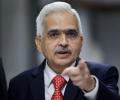
The Reserve Bank of India on Friday decided to keep the policy rate unchanged for fourth time in a row as it maintains a tight vigil on inflation. The rate increase cycle was paused in April after six consecutive rate hikes aggregating to 250 basis points since May 2022. Announcing the bi-monthly monetary policy on Friday, RBI Governor Shaktikanta Das said the Monetary Policy Committee (MPC) unanimously decided to keep the repo rate unchanged at 6.5 per cent.

'I think today RBI supervision is much sharper than what it was earlier.'

Reserve Bank of India (RBI) Governor Sanjay Malhotra said the repo rate cut in the February meeting of the monetary policy committee (MPC) was due to inflation aligning with the target and recognising the fact that monetary policy is forward-looking.
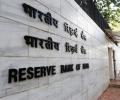
The central bank's next monetary policy review is scheduled for April 5. It had kept the policy rate unchanged in its February meeting on fears of inflation.
